
From Automation to Smart Manufacturing
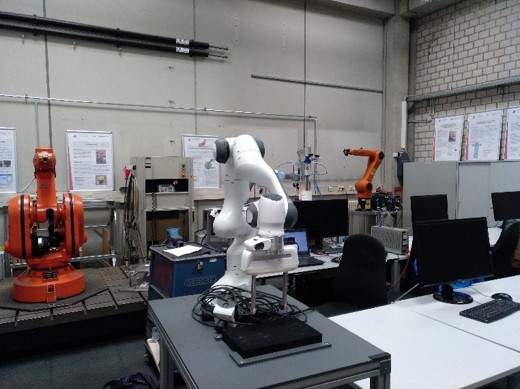
The Robotics and Production Technologies research division works at the intersection of mechanical engineering, production engineering, and computer science. It brings together robotics, additive and subtractive manufacturing, plastics processing, and the application of artificial intelligence in production.
The goal is to transfer new research findings to industry in a highly application-oriented manner—either through publicly funded projects or through direct commissions from companies.
Themen
Robotics
One area of focus is the investigation of the stability of articulated-arm robots on mobile platforms. To this end, active stabilization strategies and methods for calculating roll stability in various poses have been developed. Other work deals with coupled robots and robot-assisted machining.
Additive Manufacturing
Projects on machinery, handling technology, and processes in additive manufacturing, some with AI support. The current focus is on the FFF process; a system for the SLM process using metals is under construction.
AI in Production
Application of AI to analyze production processes and systems—to enhance process understanding, enable online process control, and support predictive maintenance.
Bionics
Applying principles from nature to technical applications. One area of focus is the development of a prosthetic hand.
Manufacturing Technology
Machining and ablative processes: milling up to 5-axis simultaneous machining, turning, ultrasonic vibration lapping, and electrical discharge machining (wire, die-sinking, and drill EDM). Services offered include feasibility studies, tool life tests, process analyses, technology development, and the machining of specialty materials.
Plastics Engineering
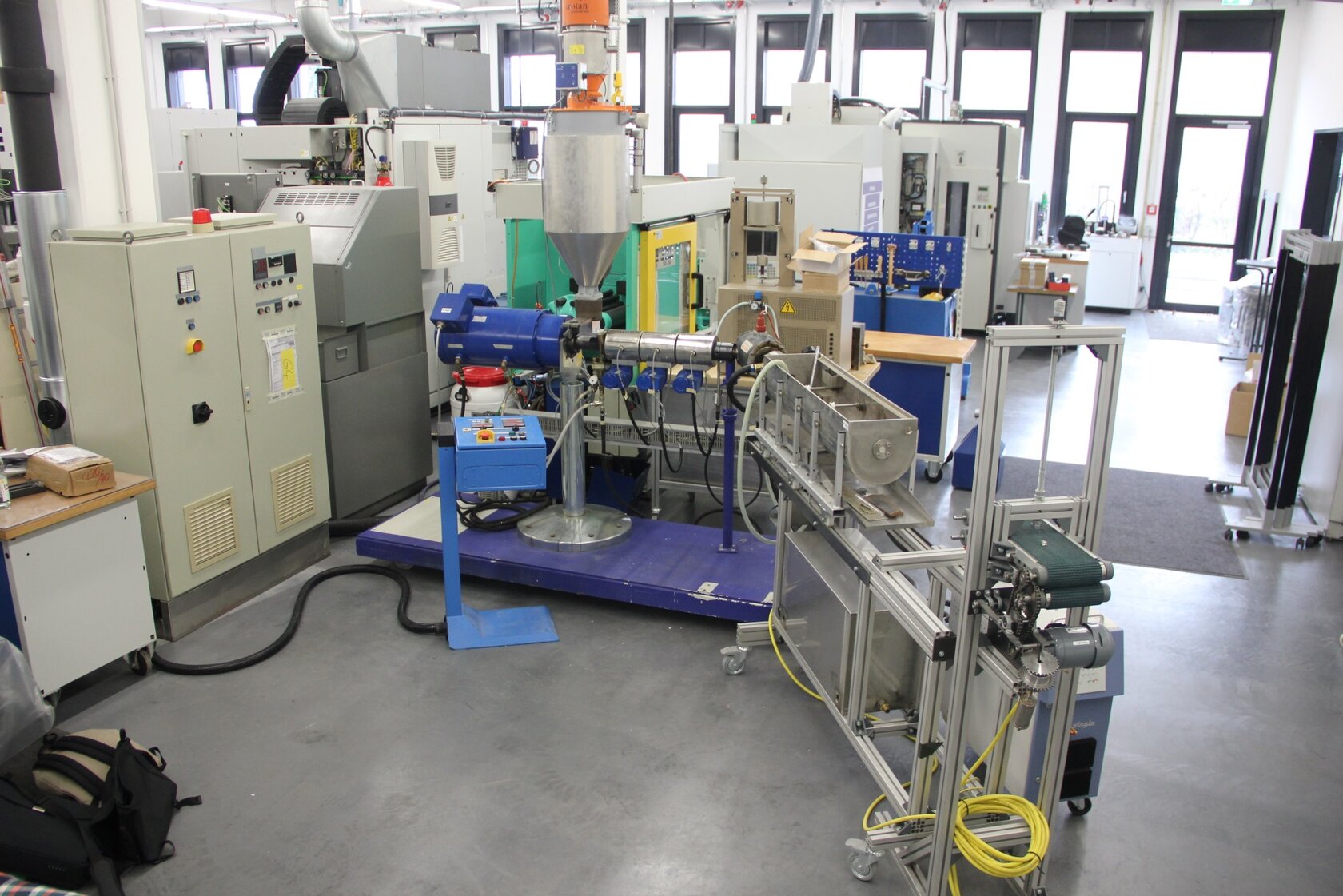
Extrusion, injection molding, additive manufacturing, and fiber-reinforced composites—such as 3D-printed mold inserts, filament production from various polymers with online quality control, a multi-component printer, and innovative sandwich structures. Additionally, support is provided for material selection for plastic products.