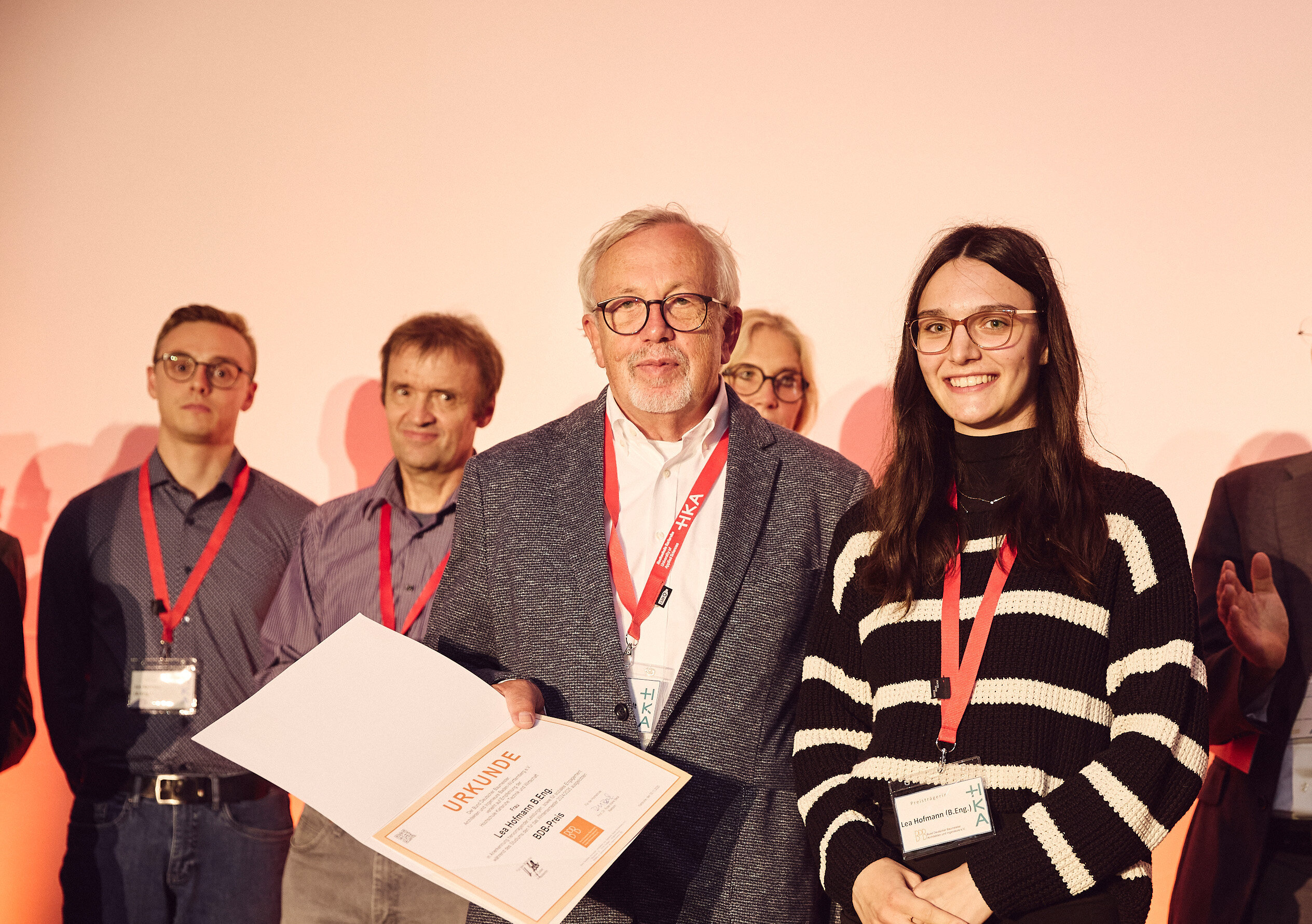
Building for the future: Between EU taxonomy and structural design
Sustainability is no longer a niche topic in the construction industry - it is an ecological necessity. As the construction sector is responsible for a massive proportion of global CO2 emissions, budding civil engineers like Lea Hofmann have a special responsibility. In her award-winning bachelor's thesis, she investigated how materials can be selected in the construction industry in line with political requirements.
HKA: What do you need to know about sustainability as a civil engineer?
Lea Hofmann (LH): The construction industry is responsible for a significant proportion of global CO2 emissions. In structural engineering, this means using as little material as possible and choosing the right building materials so that buildings last a long time. This is often measured using certificates such as the DGNB system (German Sustainable Building Council) or with the help of methods such as life cycle assessments.
Is this primarily about renewable raw materials such as wood?
LH: Yes, but wood is not suitable for every application. It's about finding the most efficient and sustainable material for the respective application. Durability is a decisive factor here.
Your bachelor's thesis is entitled "Implementing the EU taxonomy for sustainable material selection in the construction industry". What is behind it?
LH: The EU taxonomy is a regulation for sustainable investments. I investigated how these requirements are implemented in existing certification systems such as LEED (USA), BREEAM (UK) and DGNB (Germany). The result: the German DGNB system came out on top.
When is a project or product considered sustainable according to the EU taxonomy?
LH: The EU taxonomy defines six environmental objectives:
- Climate change mitigation,
- Adaptation to climate change,
- Sustainable use and protection of water and marine resources,
- Transition to a circular economy,
- Prevention and reduction of pollution,
- Protection and restoration of biodiversity and ecosystems
A project or product must fulfill the so-called "DNSH criteria" (Do No Significant Harm), i.e. it must not harm any of the environmental goals. At the same time, it must make a positive contribution to at least one of the environmental goals and comply with the minimum level of protection - this includes human rights, for example.
You are now doing your Master's degree in Munich. Does sustainability play a role there?
LH: In my Master's, I mainly wanted to deepen my knowledge in the field of structural engineering. In these lectures, the focus is on using materials according to their load-bearing behavior and making the best possible use of their strength. However, I also attended lectures such as life cycle assessment and structural maintenance to learn more about sustainability.
Who do you think civil engineering is the right course for?
LH: For anyone with an interest in construction. A good technical or mathematical understanding is an advantage, but a certain enthusiasm for construction is at least as important. And if you also want to gain international experience, you can also study the trinational course at the HKA.
Thank you very much for the interview and all the best for your Master's degree.