
Wood Meets Concrete – A Powerful Duo
Nico Nachtrieb completed his bachelor’s degree in civil engineering at the HKA and subsequently earned his master’s degree with us. Ever since completing his carpentry apprenticeship, he has been fascinated by the versatility of wood, which is why his master’s thesis — which won the Foundation Seeger und Dürr Award— focused on wood-concrete composite floors.
HKA: Mr. Nachtrieb, what are the advantages of combining wood and concrete?
Nico Nachtrieb (NN): When combined, wood and concrete form a highly effective system that brings together the best properties of both materials. Concrete absorbs the compressive forces, while wood absorbs the tensile forces. This results in an efficient cross-section that allows for higher load-bearing capacity while simultaneously reducing deformation. I found it incredibly fascinating how well these two materials complement each other.
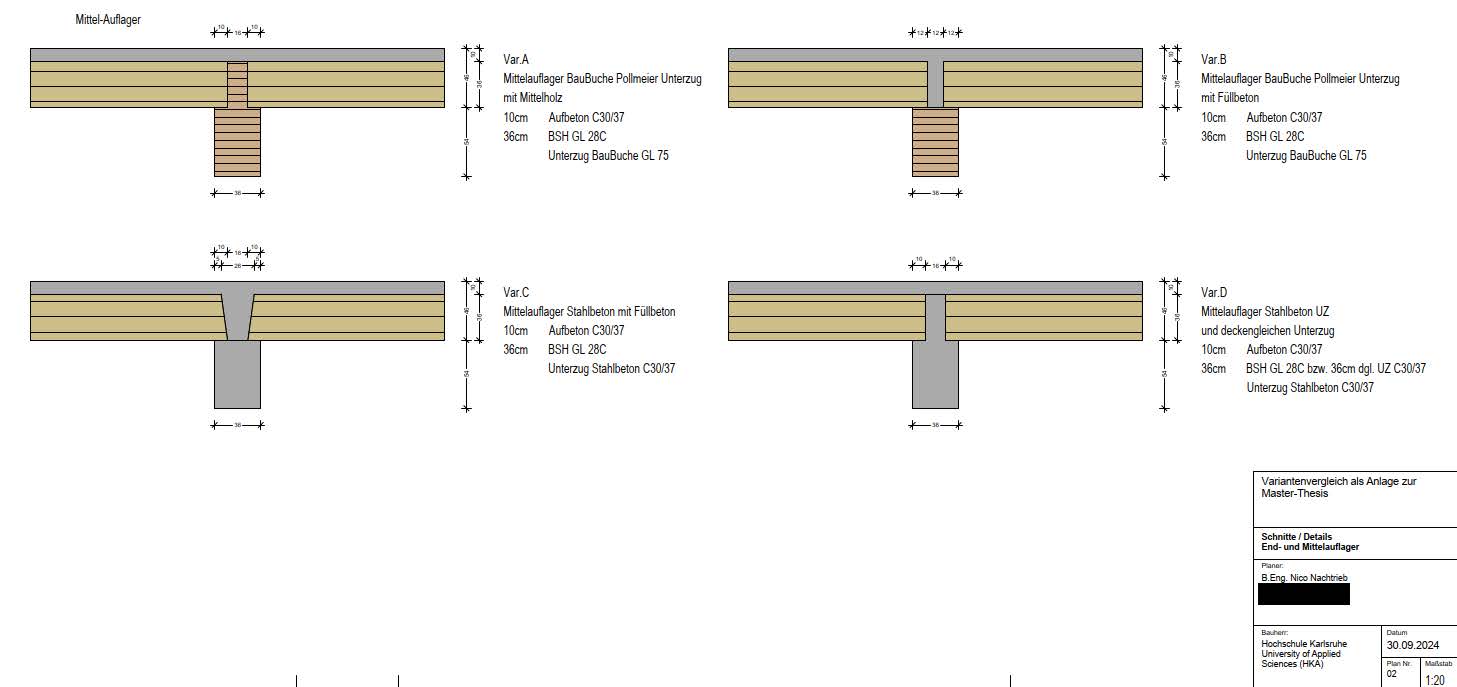
In my master’s thesis, I conducted a comprehensive parametric study to investigate which factors significantly influence the load-bearing behavior of wood-concrete composite floors. A key focus was on comparing different calculation and modeling methods. The goal was to systematically evaluate the respective strengths and limitations of these approaches and derive practical recommendations for sustainable design.

Can you give us an example?
NN: A clear example involves the formation of shear bonding between wood and concrete. One could create a composite beam using numerous screws; this is structurally sound in principle, but not necessarily sustainable.
One alternative, for example, involves incorporating notches (Editor’s note: Notches are typically rectangular or trapezoidal cuts made in a structural element to create a positive interlock) into the wood. In this case, the shear force is transferred via the positive interlock between the concrete and wood within the notch. I have analyzed such systems using various parameters. I also compared the CO₂ equivalents in an effort to develop a design that is as load-bearing and sustainable as possible.
Another advantage of such wood-concrete composite systems lies in their high degree of prefabrication. The floor elements can be precisely manufactured in the factory, transported to the construction site, and quickly assembled there. In modern timber construction, this enables the implementation of modular and efficient construction processes.
What role does timber play as a material in structural engineering in general?
NN: Timber has become increasingly important in recent years, especially in multi-storey timber construction. This is partly due to the ecological properties of the material, but also to the high degree of prefabrication and the possibilities of modular construction. Due to the comparatively low dead weight, efficient load-bearing structures can be realized.
However, it should not be underestimated that timber construction requires very careful planning. Details and connections in particular play a decisive role in the load-bearing behavior. In contrast to reinforced concrete construction, for example, structural adjustments can only be made to a limited extent on the construction site due to the high level of prefabrication. This is why well thought-out preliminary planning is particularly important in timber construction.
Where are you working now?
NN: After finishing my studies, I ended up in structural engineering at IngenieurGruppe Bauen in Karlsruhe, where I work on a wide variety of building construction projects.
Currently, my focus is on masonry construction, with some elements of timber construction that come up from time to time. I’m currently working in the field of structural engineering review for building construction. That means I review structural calculations. In Germany, the dual-review principle applies to larger construction projects. One firm prepares the structural design, which is then reviewed by a reviewing engineer. On behalf of the reviewing engineer, I review the documentation, scrutinize the structural calculations, and conduct random construction site inspections. In doing so, I get to know a wide variety of projects. I also work with many experienced engineers, which is why I’m learning a lot here.
“Learning” is a good keyword — how well did your studies at the HKA prepare you for your current profession?
NN: Of course, you realize there’s a difference between college and the real world. Construction is an incredibly broad field that you can’t fully master in ten semesters. But I believe that the university prepared me very well, especially because we had so many hands-on projects. Since there were sometimes only ten or twenty of us in the seminars, we also had a very good relationship with the professors and many discussions on equal footing—that was truly invaluable. Professional practice, however, keeps showing that there’s still a lot to learn, but that’s exactly what’s so great about engineering.
Would you study at HKA again?
NN: Yes, absolutely. I especially found the transition after my apprenticeship to be very smooth. For example, I had a bit of trouble with math, but thanks to the strong support I received at the university, I was able to manage it all very well — and today I work in structural engineering.
Thank you very much for the interview!