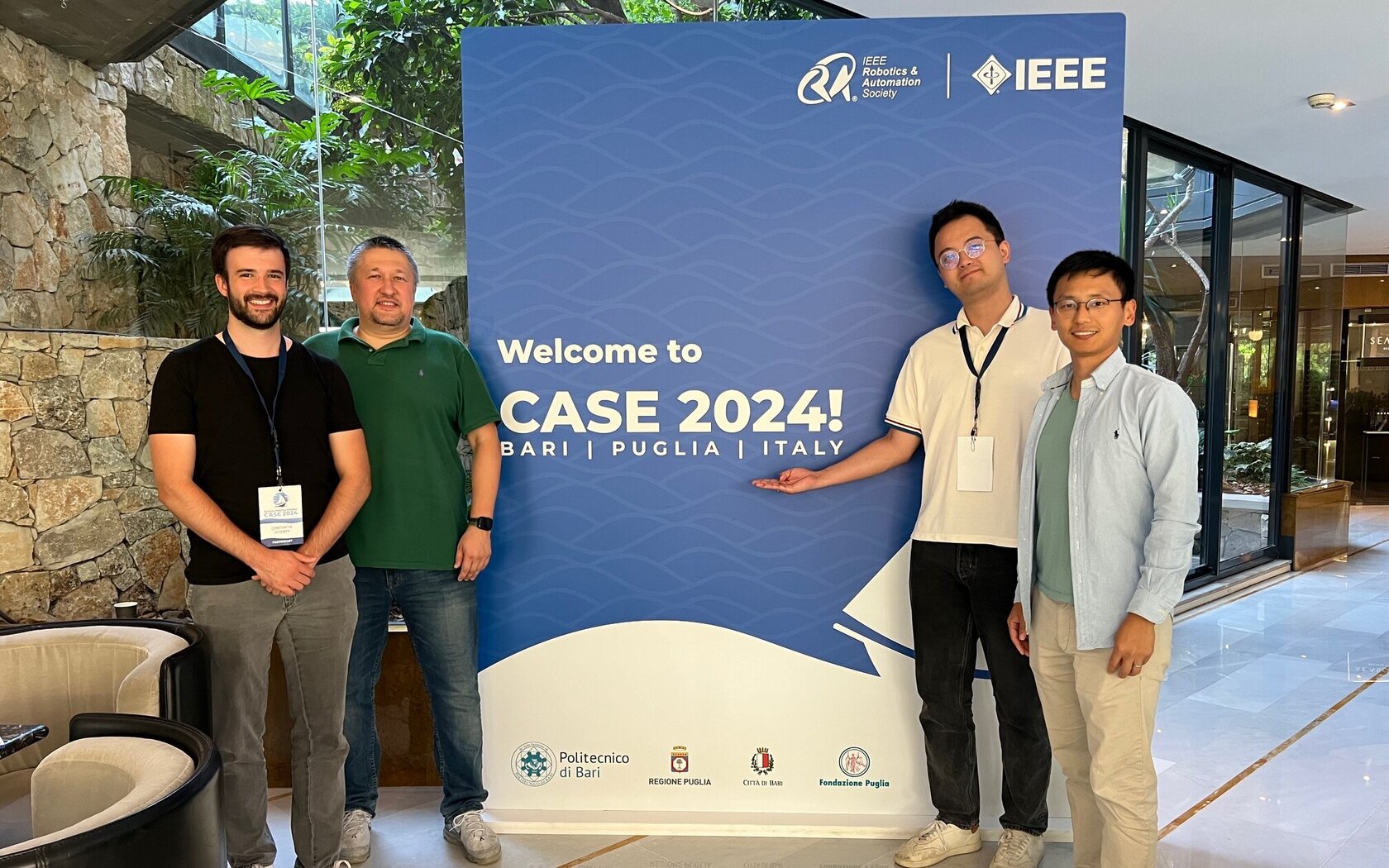
At the end of August, part of our team and our colleagues from Proximity were together at CASE2024 in Bari, Italy. There, they presented their various papers and exchanged views with the assembled community on current research issues and challenges and were able to find new inspiration for their own research.
An insight into the paper by Yongzhou Zhang:
Conquering the Robotic Software Development Cycle at Scale: Using KubeROS from Simulation to Real-world Deployment
The paper deals with the improvement of robotic algorithms using closed-loop workflows. These closed-loop workflows are based on the KubeROS platform using the example of robot navigation (with Nav2 in ROS2). The aim is to develop and test robot algorithms more efficiently and to transfer them from research to practice. With the help of the massive resource of Cloud/Edge and the BatchJob, the software stack is tested and fine-tuned in various stages on benchmark data sets and simulation environments with domain randomization in large scalars.
The work was carried out as part of the KI5GRob project (funded by the BMBF).
An insight into the paper by Constantin Schempp:
PIPE: Process Informed Parameter Estimation, a learning based approach to task generalized system identification.
The paper addresses the problem of robot-guided assembly tasks by using a learning-based approach to identify contact model parameters for known and new components. First, a variational autoencoder (VAE) is used to extract geometric features of assembly parts. Then, the extracted features are combined with physical knowledge to derive the parameters of a contact model using our newly proposed neural network structure. The force measured in real experiments is used to monitor the predicted forces, eliminating the need for real model parameters. Although the network was only trained with a small set of assembly parts, a good contact model estimation could be achieved for unknown objects.
The main contribution lies in the network structure, which makes it possible to estimate contact models for assembly tasks depending on the geometry of the part to be joined. While current system identification processes need to acquire new data for a new assembly operation, this method only requires the 3D model of the assembly part.
An insight into the paper by Yucheng Tang:
Enhancing Logistics Automation: Integrating Capacitive Proximity and Tactile Sensors for Trolley Pose and Center of Mass Estimation
This paper presents a concept that utilizes capacitive sensors to reduce clearance width and provide robust material handling. Initial results for estimating the position of a trolley in a drive-in task and a proof of concept for estimating the center of mass of a trolley using a capacitive sensor system are presented. The approach provides a marker-free and infrastructure-independent method for relative position estimation of the cart and for updating the localization of the mobile robot. The sensors, which measure capacitive fluctuations in the electromagnetic field, are mounted on an autonomous mobile robot. Two capacitive proximity sensor units with 16 electrodes each are mounted on top of the robot. The method is based on principal component analysis and enables the position estimation of I-shaped profiles based on proximity feedback.
A robotic arm was used to evaluate the method to capture profiles above the sensor array and use them as ground truth. The sensors were then mounted on a mobile robot and evaluated in a drive-in task, achieving comparable results to current visual-based approaches. Four additional tactile sensor modules are installed under the sensor array, which were used to estimate the center of gravity of the object using the multipoint weighing method and achieve a repeatability of about 50g.
This project is independent of the university projects; funding was provided by Proximity Robotics & Automation GmbH.
Congratulations to our colleagues Constantin Schempp, Yongzhou Zhang, Yucheng Tang and Ilshat Mamaev!