According to Emmons' (1951) turbulent spot theory, the intermittency distribution characterizing the laminar-to-turbulent transition in boundary layer flow depends on the formation of turbulent spots and their kinematics as they convect downstream.
While the assumption of a concentrated spot breakdown may suffice to model natural transition, Mayle and Stripf (2021) found that under high free-stream turbulence, i.e. bypass transition, the production of incipient spots (i-spots) occurs in a distributed manner. Particularly in flows with favorable pressure gradients, their analysis of hot-film measurements showed that i-spot production extends over a considerably long area. Moreover, it supports the idea that i-spot formation is suppressed in the laminar becalmed wakes of turbulent spots, which falls in line with the calming effect observed by Schubauer and Klebanoff (1956).
In light of this, only transition models considering both the distributed i-spot production and the suppressing effect of becalmed flow have the potential to predict (bypass) transition. Fortunately, Emmons' theory provides the foundation for modeling turbulent and laminar (non-)becalmed intermittency distributions while accounting for both effects. To the authors' knowledge, no onset model yet exists that adequately predicts the production rate under various flow conditions. The key reason for this is the loss of distinction between laminar and turbulent flow - and particularly between laminar becalmed and non-becalmed regions - in the classic Reynolds-averaged Navier-Stokes equations (RANS).
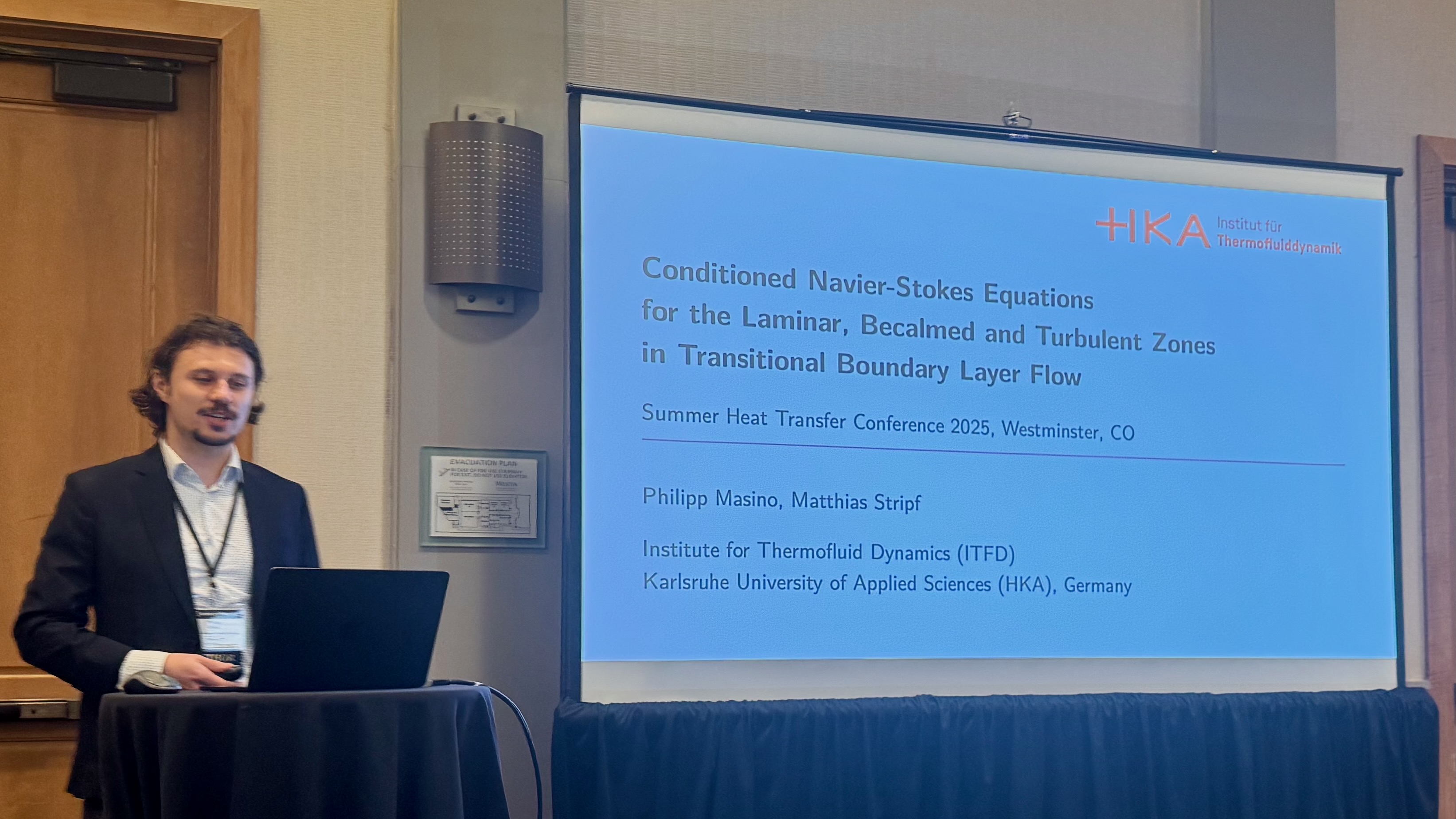
Building on Steelant and Dick (1996), this work presents a conditional averaging approach distinguishing three flow states: turbulent, laminar becalmed and laminar non-becalmed, to numerically solve the boundary layer equations undergoing bypass transition. One indicator function is defined per flow state and multiplied with the mass and momentum conservation equations before time averaging. This yields a set of three interdependant conditionally averaged Navier--Stokes equations (CANSE) that include additional terms for inter-regional mass and momentum exchange.
Analyzing the exchange terms from a physical point of view shows that the inter-regional mass transport is proportional to three parameters. The first one is the passing frequency of the regional interfaces, over which the transport occurs. The second one is the difference in flow velocity on adjacent sides of the interfaces. Finally, mass exchange is inversly proportional to the interface velocities, as faster edges have a shorter length of stay in a considered fluid element. The inter-regional momentum transport is proportional to the mass exchange and a mean transport velocity over the interfaces. With the help of hot-film measurements tracking the spot-passing frequencies, inter-regional mass and momentum exchange can be calculated.
The conditionally averaged parabolic boundary layer equations are solved stepwise in streamwise direction using a finite difference scheme. At each new downstream position, the mass and momentum conservation equations are solved iteratively. This results in unique velocity profiles for the three flow regions. The Reynolds-averaged solution is readily recovered as a weighted sum based on their respective intermittency factors.
First numerical solutions of the CANSE for one test case of interest are presented. Near the beginning of transition, the numerical simulation is stable. However, analysis of velocity profiles in the late transition region suggest the need of laminar fluctuation models to stabilize the laminar profiles.
Further model development and future validation using detailed hot-wire measurements of the conditionally-averaged velocity profiles will establish this approach as a solid foundation for a new physics-based transition model. It paves the way for investigations correlating the distributed i-spot production with the free-stream turbulence and laminar flow characteristics.