Karlsruhe, 19 February 2026 - Imagine a screw sorting system suddenly no longer recognizes screws because their color has changed, even though this is not relevant to their function. Or a quality inspection in production fails because strong reflections occur depending on the position of the sun. The new "DeepFrame" research project, which is being carried out by a consortium from science and industry, aims to solve precisely such problems.
Strong consortium for applied AI research
In addition to the Karlsruhe University of Applied Sciences / IRAS (Institute for Robotics and Autonomous Systems), the companies VisionTools Bildanalyse Systeme GmbH, Elma Electronic GmbH and DE software & control GmbH are involved in the DeepFrame project as partners. BMW AG supports the project as an associated partner and provides the project with industrial use cases.
The project is funded by the Federal Ministry of Research, Technology and Space (BMFTR). The consortium is working together to make AI systems for industrial applications more reliable and robust.
Artificial intelligence often works excellently today, but only under ideal conditions. As soon as lighting conditions change, sensors become dirty or unforeseen situations arise, many systems reach their limits. It's like a student who has memorized something but can't get any further with a slightly different question. This is exactly where DeepFrame comes in: The research team develops AI systems that not only work, but also remain reliable under difficult conditions.
Training in virtual worlds
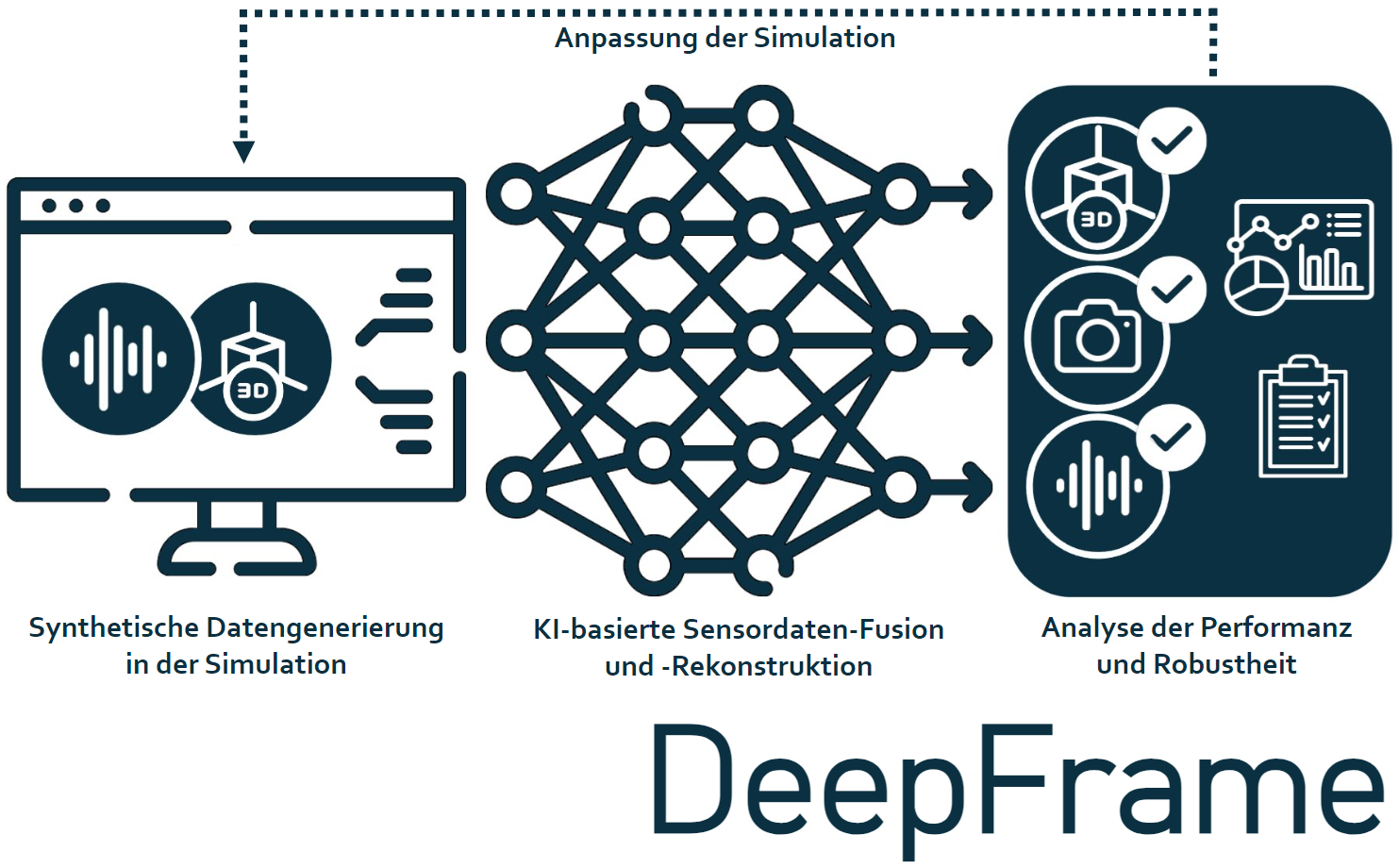
A special highlight of the project: instead of laboriously recording and describing thousands of real images, the consortium trains AI systems with virtually generated data from simulations. This is comparable to flight simulators for pilots. We can run through any number of scenarios, from perfect to extreme conditions. No real component needs to be photographed.
This synthetic training data is not only more cost-effective, but also makes it possible to specifically simulate critical situations:
What happens in backlighting? How does the system react to shadows or reflections? Can missing parts be reliably detected? "We know how demanding our customers' challenges are," explains Josef Djulic, Managing Director of VisionTools. "With the innovations from DeepFrame, we offer solutions that are not only more reliable, but also easier to integrate. Our products such as VisionCockpit make it easy to train complex image processing systems, while the VoE-AIBox provides AI-based evaluation algorithms directly on the line. In this way, we support our customers in increasing their productivity, optimizing processes and securing decisive competitive advantages."
A second research focus is the combination of different sensor types - similar to how humans perceive their environment through the interaction of eyes, ears and touch. DeepFrame develops AI models that intelligently combine data from several sensors, such as color cameras or thermal imaging cameras. The advantage: if one sensor fails or provides inaccurate data, the others can compensate for this.
"Our expertise in embedded computing solutions enables us to transfer AI developments directly to powerful hardware," explains Aksel Saltuklar, CTO of Elma Electronic. "We are proud to create the technological basis for these innovative applications with our systems."
"We are integrating the AI functionalities into our smart worker assistance system," explains Friedrich Steininger, CEO of DE software & control." With workstAItion 5.0, DE offers the ideal framework for using technological innovations in the field of improved image recognition and multimodal sensors in a process-oriented manner. This will enable us to make our worker assistance system even more resilient and easier to configure at the same time."
Possible applications extend far beyond industry: in agriculture, robust AI systems could monitor plants under a wide range of weather conditions. And in the rescue sector, they could keep search and rescue robots operational even in poor visibility or smoke-filled rooms.
Tailor-made for German SMEs
While American tech giants such as Google and Meta in particular rely on huge amounts of data, the DeepFrame consortium is developing solutions for small and medium-sized companies that are unable to invest millions of euros in training data. The methods are resource-efficient and practical, which is exactly what German industry needs.
The DeepFrame consortium:
VisionTools Bildanalyse Systeme GmbH One of the leading system houses for industrial image processing in Germany.
Elma Electronic GmbH The world's leading provider of embedded computing solutions.
DE software & control GmbH Specialist for software and highly flexible automation solutions, in particular smart worker assistance systems.
BMW AG (associated partner) Globally active automobile and motorcycle manufacturer for innovative premium vehicles
Karlsruhe University of Applied Sciences - Institute for Robotics and Autonomous Systems (IRAS) Institute for applied AI research with a focus on robotics and intelligent systems.
The project is funded by
The DeepFrame project is funded by the Federal Ministry of Research, Technology and Research Promotion (BMFTR) as part of the "FH-Kooperativ" funding lines.