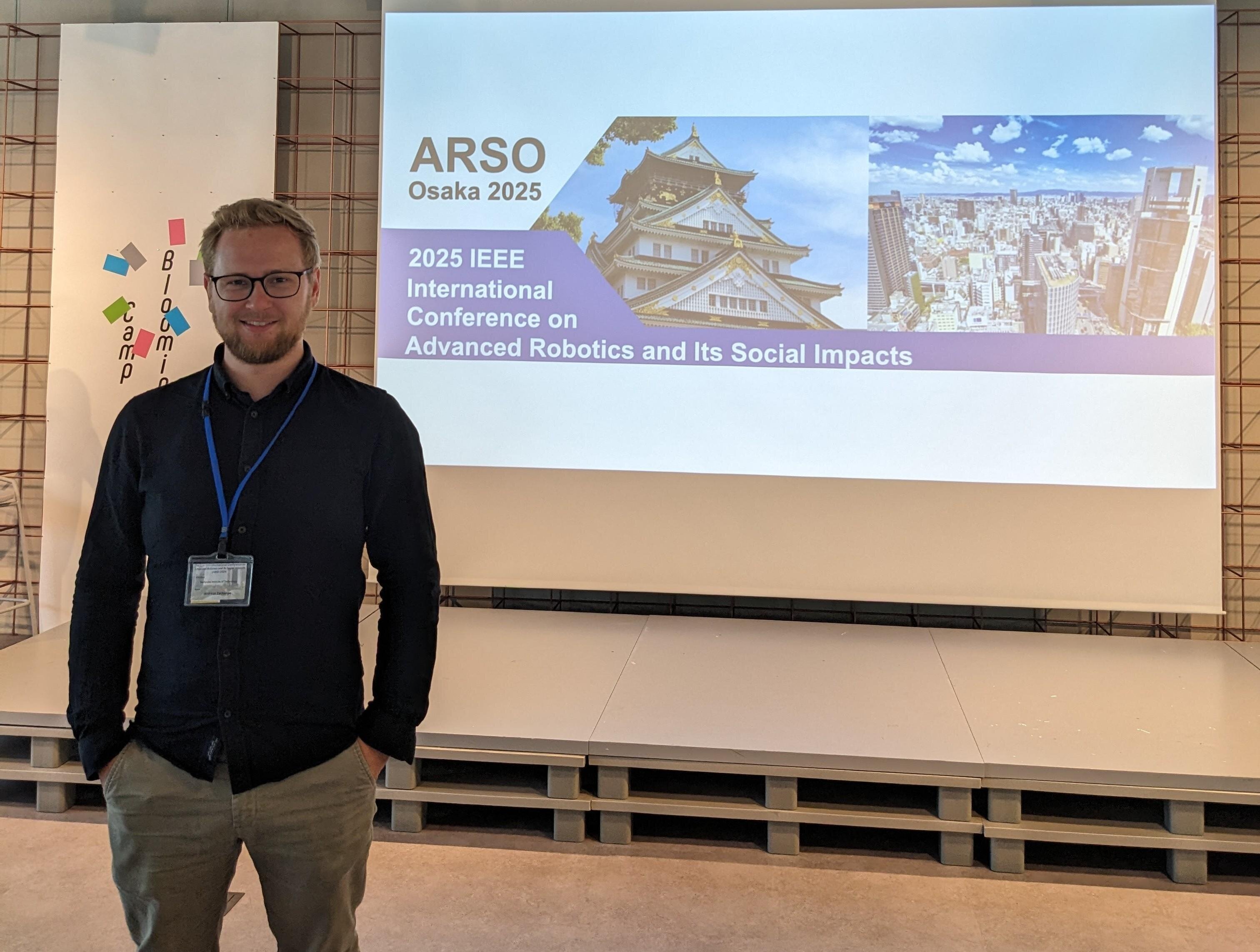
From July 17 to 19, 2025, the 21st IEEE International Conference on Advanced Robotics and Its Social Impacts (ARSO) took place in Osaka, Japan. The conference brings together international researchers, industry representatives, and policy makers to discuss the intersections of advanced robotics, society, and ethics.
This year, IRAS was represented by Andreas Zachariae, who presented his paper Towards Automated, Individualized, and Adaptive Lower-Limb Motor Training with a Force-Controlled Robotic Walker, addressing the potential of robot-assisted rehabilitation.
The paper focuses on one of the key challenges in modern rehabilitation:
How can robots enable individualized, adaptive training that is both automated and effective?
In contrast to standardized "one-size-fits-all" programs, which often fail to meet the needs of individual patients, Andreas’ approach aims at tailored training programs. These can take into account the user’s performance level, provide targeted challenges, and continuously adapt over time.
The work addresses three key aspects:
- Review of the state of the art
The paper provides a comprehensive overview of existing methods for individualized motor training, with a particular focus on automatic performance assessment, adaptive task difficulty, and dynamic scheduling of exercise sessions. - User study with the RoboTrainer
The study investigated to what extent the RoboTrainer – a robotic walker developed at IRAS – is technically capable of supporting adaptive training. Key aspects included the measurement of gait parameters (such as stride length and frequency) as well as the potential for situation-dependent training control. The results show that the RoboTrainer provides a solid foundation for personalized therapy approaches. - Presentation of the RoboTrainerAID framework
As a next step, the concept of RoboTrainerAID was introduced – a framework that employs machine learning methods to adapt training in real time to the user’s performance.- An algorithm automatically assesses how well exercises are carried out.
- Based on this assessment, task difficulty is adjusted – for example, by varying spatial movement requirements.
- The goal is an individually tailored training plan that dynamically responds to progress or difficulties.
With this concept, the aim is not only to increase the effectiveness of rehabilitation, but also to relieve healthcare resources – a decisive factor in light of the shortage of skilled workers and an aging society.
Conclusion
With his research in the field of assistive robotics for medical applications, Andreas Zachariae makes an important contribution to the international discussion on the use of robotics in rehabilitation. Participation in ARSO 2025 provided an excellent opportunity to present results, receive valuable feedback, and gather new impulses for future work.