
ECOLITH
ECOLITH – Energy- and CO2-Optimized Laboratory and IT Operations

Motivation
Digitalization opens up great opportunities for universities: It enables more efficient processes, new forms of research and teaching, and increasing automation of technical workflows. At the same time, however, it leads to growing energy demand and associated CO₂ emissions. In particular, energy-intensive digital and technical infrastructures—such as data centers, high-performance computing clusters, and laboratories—contribute significantly to energy consumption.
This is especially relevant for Baden-Württemberg, as the state is pursuing the goal of achieving a greenhouse gas-neutral state administration by 2030. Universities play a central role in this effort: they have large building spaces and operate numerous infrastructure systems that are indispensable for research and teaching but require significantly more energy than lecture halls and offices. Since these infrastructure systems involve high investments and cannot be replaced in the short term, a key strategy lies in making their use smarter, more efficient, and more climate-friendly.
One promising approach is to better schedule energy-intensive processes. If computing jobs, laboratory activities, or other processes can be specifically shifted to time slots with high availability of renewable energy, CO₂ emissions from existing infrastructure can be reduced without limiting its performance. At the same time, better utilization can help make more efficient use of existing resources.
This is where the ECOLITH project comes in. The goal is to research AI-supported methods for proactive process and usage planning of energy-intensive university infrastructures. By combining forecasts, predictive scheduling, data-driven learning methods, and generative language models, the project aims to support decisions on when and how computing clusters and laboratories can be operated in the most energy- and CO₂-efficient manner possible. The focus is not only on technical optimization potential but also on transparency, traceability, and user acceptance.
ECOLITH thus contributes to the sustainable transformation of university operations. The project investigates how the operation of existing infrastructures can be made more environmentally friendly through intelligent planning and lays the groundwork for transferable solutions that can eventually be implemented across universities.
Objectives
ECOLITH aims to operate energy-intensive university infrastructures more efficiently, flexibly, and in a more climate-friendly manner. The central question is how existing computing and laboratory infrastructures can be better adapted to energy demand, utilization rates, and the availability of renewable energy through forward-looking planning.
The project focuses on the following objectives:
- Development of forecasting models for energy demand, usage patterns, and utilization rates of data centers, high-performance clusters, and laboratories.
- Research into AI-based scheduling methods that enable flexible workflows to be planned with energy and CO₂ efficiency in mind.
- CO₂-optimized orchestration of computationally intensive IT workloads, such as AI training, AI inference, big data analytics, or other data-intensive tasks.
- Intelligent scheduling of laboratory activities, taking into account technical, organizational, and personnel constraints.
- Use of federated learning methods to develop cross-university models without centrally aggregating sensitive operational or usage data.
- Development of a user-oriented ECOLITH platform that makes planning proposals transparent and actively involves users in decision-making processes.
The approaches developed will be tested on real-world infrastructures at HKA and its transfer partners. In the long term, the results should also be transferable to other universities, research institutions, and companies.
Methodology
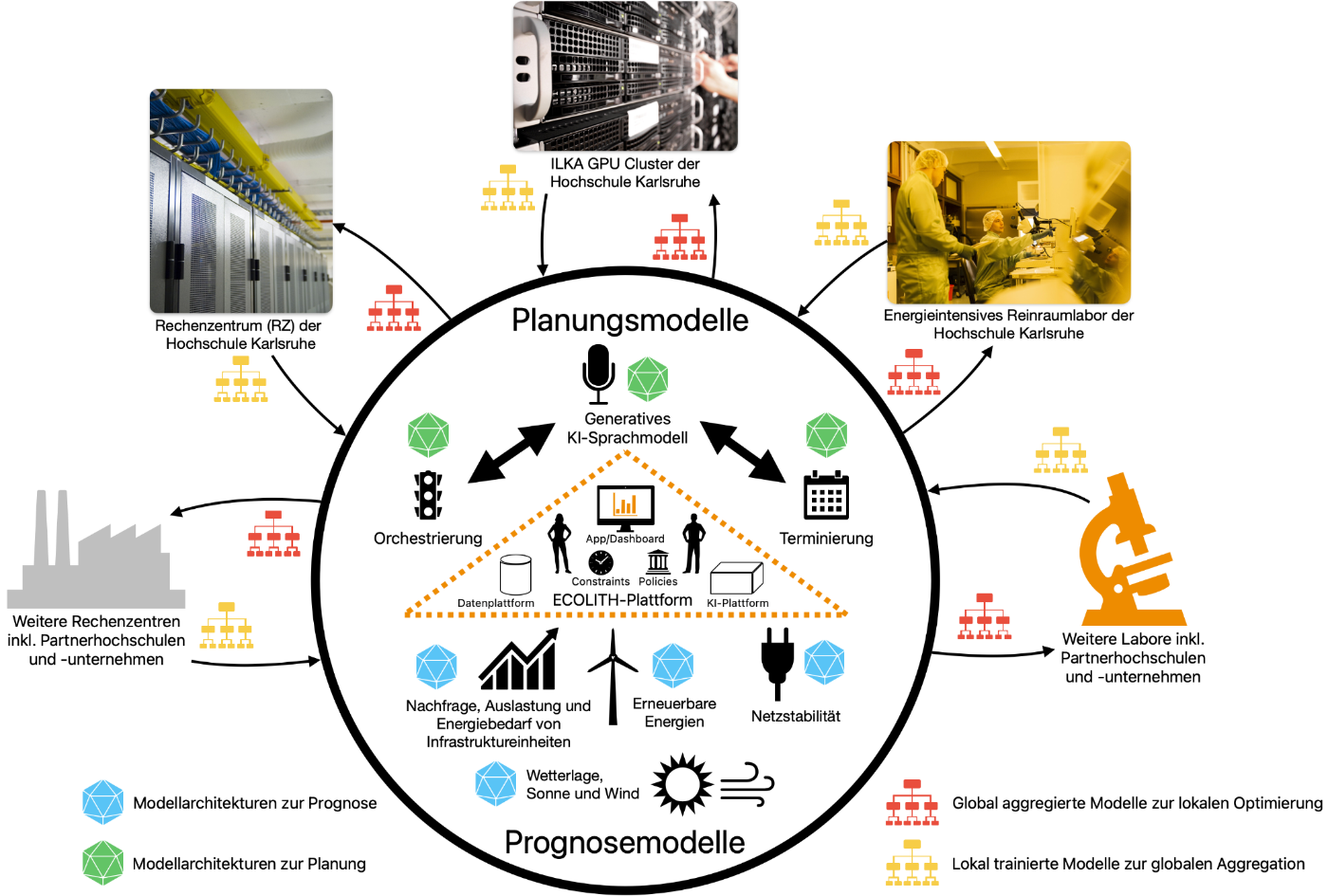
ECOLITH’s methodology is based on AI-supported, predictive process and usage planning for energy-intensive university infrastructures. To this end, data from data centers, high-performance clusters, and laboratories is collected and linked with forecasts regarding the availability of renewable energy, expected energy consumption, and user demand. Based on this, AI models will predict future energy requirements, utilization rates, and suitable time windows for CO₂-optimized operation.
Various machine learning and optimization methods are being investigated for planning purposes. The focus is on reinforcement learning, which enables dynamic adaptation of scheduling decisions to changing conditions. In addition, federated learning is used to train models across universities without centrally aggregating sensitive operational or usage data.
The developed methods are integrated into the ECOLITH platform. This platform includes components for data management, AI model training, inference services, and an app featuring a dashboard and natural language interaction. Users will be able to view energy consumption, define rules, and review or adjust proposed plans.
The methodology is being tested on specific use cases at HKA and its partners: the CO₂-optimized orchestration of energy-intensive IT workloads and the scheduling of activities in energy-intensive laboratories. In this way, ECOLITH combines data-driven forecasts, AI-supported planning, and user-centered operation into a practical approach for sustainable university infrastructures.
Project Duration
01.06.2026 - 31.05.2029
Contact
Internal Partners

Project Funding
This project is funded by the Carl-Zeiss-Stiftung.