Borderless E-Mobility – A Federated Charging Park for Sustainable Freight Transport in the Upper Rhine
The Institute for Data-centric Software Systems (IDSS) at Karlsruhe University of Applied Sciences acts as the lead partner of the Interreg Upper Rhine project eTruckCharge, coordinating the collaboration of 12 partners from Germany, France and Switzerland.
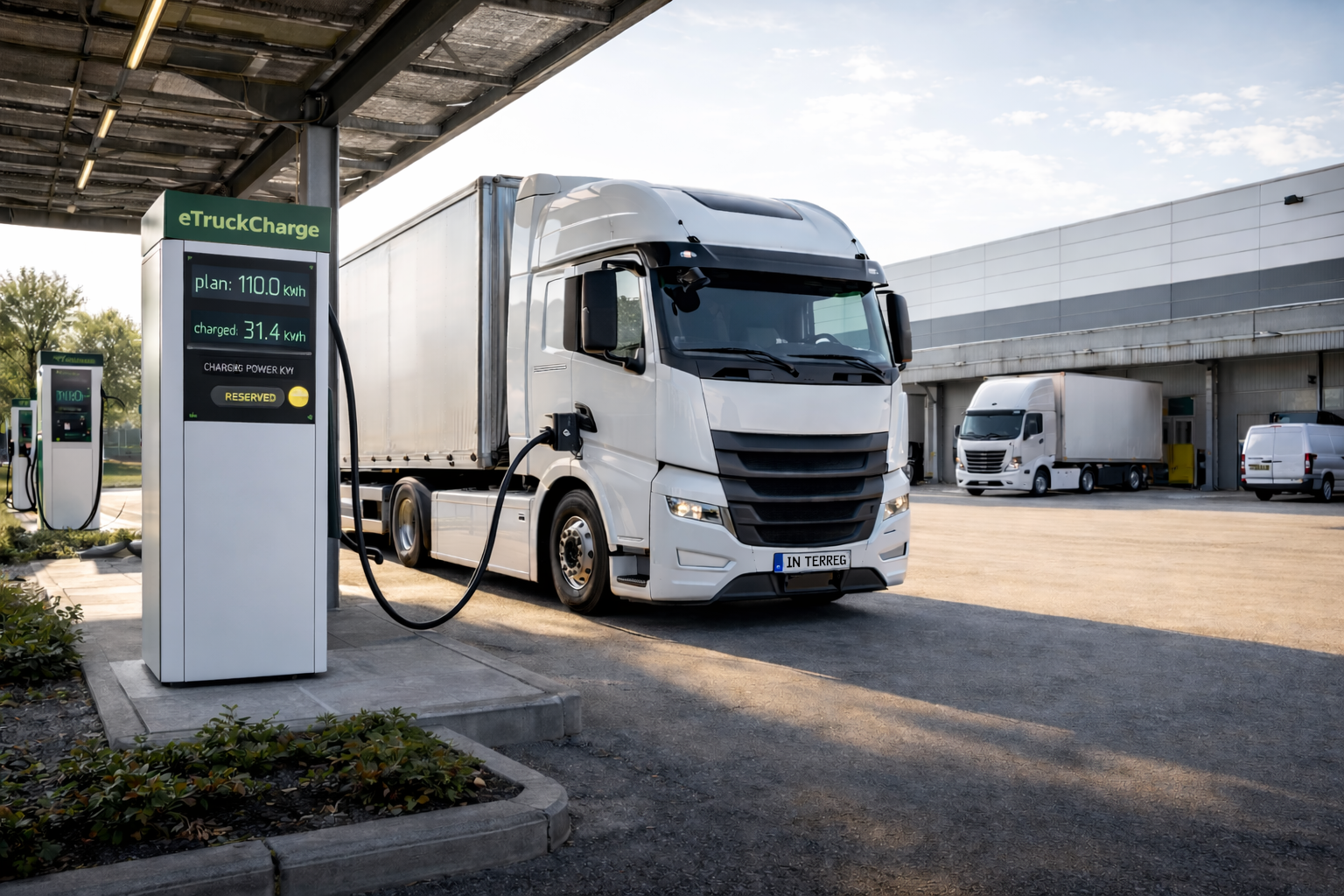
The goal of the project is to design a cross-border and cross-company “federated charging network” for electric trucks in the Upper Rhine region: Charging capacities already available at commercial sites—logistics centers, warehouses, vehicle depots, and industrial parks—are to be made accessible and bookable for business partners and other users through an IT system developed as part of the project. This will enable freight forwarders to reserve charging capacity along their routes and plan cross-border trips safely and reliably. In addition to project coordination, the IDSS is contributing its expertise in the areas of distributed software systems and e-mobility: The institute is developing a software system to manage the federated charging network, which will enable companies to share their charging capacity in a controlled manner across organizational boundaries. In addition, we are working on digital twins for real-time mapping of the charging infrastructure, as well as on federated training methods for forecasting, which can predict occupancy, arrival and departure times, and peak loads without the need to centrally aggregate training data. The eTruckCharge project (Project Ref.: B1-8) is co-financed under the Interreg Upper Rhine program with funds from the European Regional Development Fund (ERDF) of the European Union.
Official project page on Interreg Upper Rhine
Interreg Upper Rhine
Motivation
How can the charging infrastructure for electric trucks—which is already in place at logistics centers, warehouses, and vehicle depots along the Upper Rhine—be used across borders and companies in the future? That is precisely what the eTruckCharge research project is investigating.
The main research questions of the project are:
- How can an IT system be designed that allows companies to grant controlled access to their charging stations for business partners and make them bookable—in the sense of a “federated charging network”?
- How can AI be used to forecast charging needs while the vehicle is still in motion and to mathematically optimize the control of charging processes—while taking locally applicable electricity prices into account?
- How can an AI-powered system for attack and anomaly detection be designed based on federated learning—without exchanging any sensitive raw data?
Funded Project Partners
- Karlsruhe University of Applied Sciences – Consortium leader, represented by the Institute of Data-Centric Software Systems (IDSS)
- RPTU – Lehrstuhl für Mechatronik in Maschinenbau und Fahrzeugtechnik
- CESI – Campus de Strasbourg
- Chambre de Commerce et d'Industrie Alsace Eurométropole
- Eurométropole de Strasbourg
- FHNW University of Applied Sciences and Arts Northwestern Switzerland – Institute of Mobile and Distributed Systems (IMVS)
Associated Partners
- Technologie Region Karlsruhe GmbH
- Verband Region Rhein-Neckar
- Walter Schmitt GmbH
- Fachspedition Karl Dischinger GmbH
- Land Rheinland-Pfalz – Ministerium des Innern, für Integration und Verkehr
- CHARGEMAP SAS
Partner Contributions
Contact
Project Coordinator
Prof. Dr.-Ing. Zoltán Nochta
Project Funding
The eTruckCharge project (Project Ref.: B1-8) is co-financed under the Upper Rhine Interreg Program with funds from the European Union’s European Regional Development Fund (ERDF). The Swiss Confederation (New Regional Policy, NPR) and the cantons of Basel-Landschaft, Basel-Stadt, and Solothurn are contributing to the funding of the FHNW University of Applied Sciences and Arts Northwestern Switzerland.