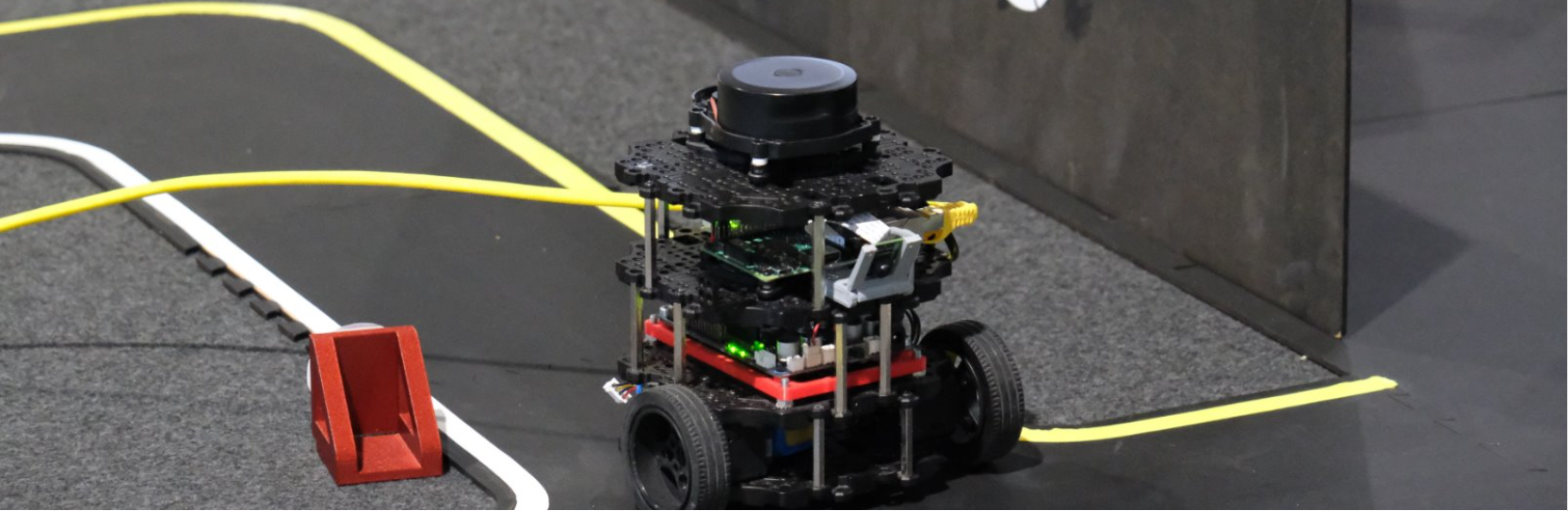
The Upper Rhine Mobile Robotics Challenge 2024 was a complete success for our institute and Karlsruhe University of Applied Sciences! As the only non-French teams, our students prevailed against strong competition from France and Alsace - and secured first and second place.
A demanding competition with realistic challenges
The Upper Rhine Mobile Robotics Challenge takes place every two years as part of the BE5.0 trade fair in Mulhouse and challenges teams from different universities to test their mobile robot systems in complex scenarios. The event is not only an excellent opportunity to exchange ideas and get to know new students across universities and colleges, but also offers a chance to put the theory from their studies into practice and test it under special conditions.
3 months before the deadline and the start of the on-site challenge, the teams are given the first tasks and thus have the opportunity to get to know the setup, familiarize themselves with the challenges and set up the mobile robots. The mobile robots are a special feature of this challenge, as each team is provided with a Turtlebot Model 3 by the organizer in order to guarantee equal opportunities.
The tasks for the competition included, among other things
- Lane following - The robot had to follow a defined lane.
- Obstacle avoidance - The robot was not allowed to touch any unforeseen objects on the route.
- Tunnel passage - The robot had to enter and exit a tunnel autonomously.
- Parking maneuver - Precise parking under time pressure.
- Combination of all missions - The ultimate challenge for the teams.
Hurdles and challenges - improvisation required!
As in any competition, rarely does everything work according to plan, and the teams of the Upper Rhine Mobile Robotics Challenge2024 were not spared.
- Poor internet connection
- Language barriers
- Changed route conditions
- Rethinking, recoding and readjusting overnight.
On the first day, it turned out that the Wi-Fi connection was not stable enough to provide the student teams and their robots with a constant network connection, as well as the trade fair visitors. As a result, the Wi-Fi connection was unreliable and dropped out at the most inconvenient times. For the teams, this meant a long troubleshooting process, as the problem initially fell back on the teams and the development of the Turtlebot. The test phases on the course were therefore also very short on the first day, as the mobile robots regularly stopped and lost their signal.
In addition to the poor internet connection, the language barrier was another factor that made the work of the German teams more difficult. Important information and updates were very slow to find their way to the five HKA students. Delays and misunderstandings were the result of the language barrier, but our teams were still able to exchange information with the other students, help out and establish contact.
Teamwork & creativity as the key to success
The competition was not only an endurance test for technical implementation and team cohesion, but also a valuable experience for our students. According to them, the following three points were the key factors:
- Practice under pressure - Theory was tested under real conditions.
- Creative problem solving - Unexpected problems had to be solved in the shortest possible time.
- Teamwork - working on different problems in parallel was essential.
A real game changer was the reprogramming of the lane departure warning system, which allowed the Turtlebot to navigate through the challenges with greater stability and precision. According to one of the teams, this reprogramming will also have led to victory, despite all the obstacles on site.
The well-deserved trophy for the double victory is now in our office - and the experience gained from the competition will flow into the next generation of students at the HKA.