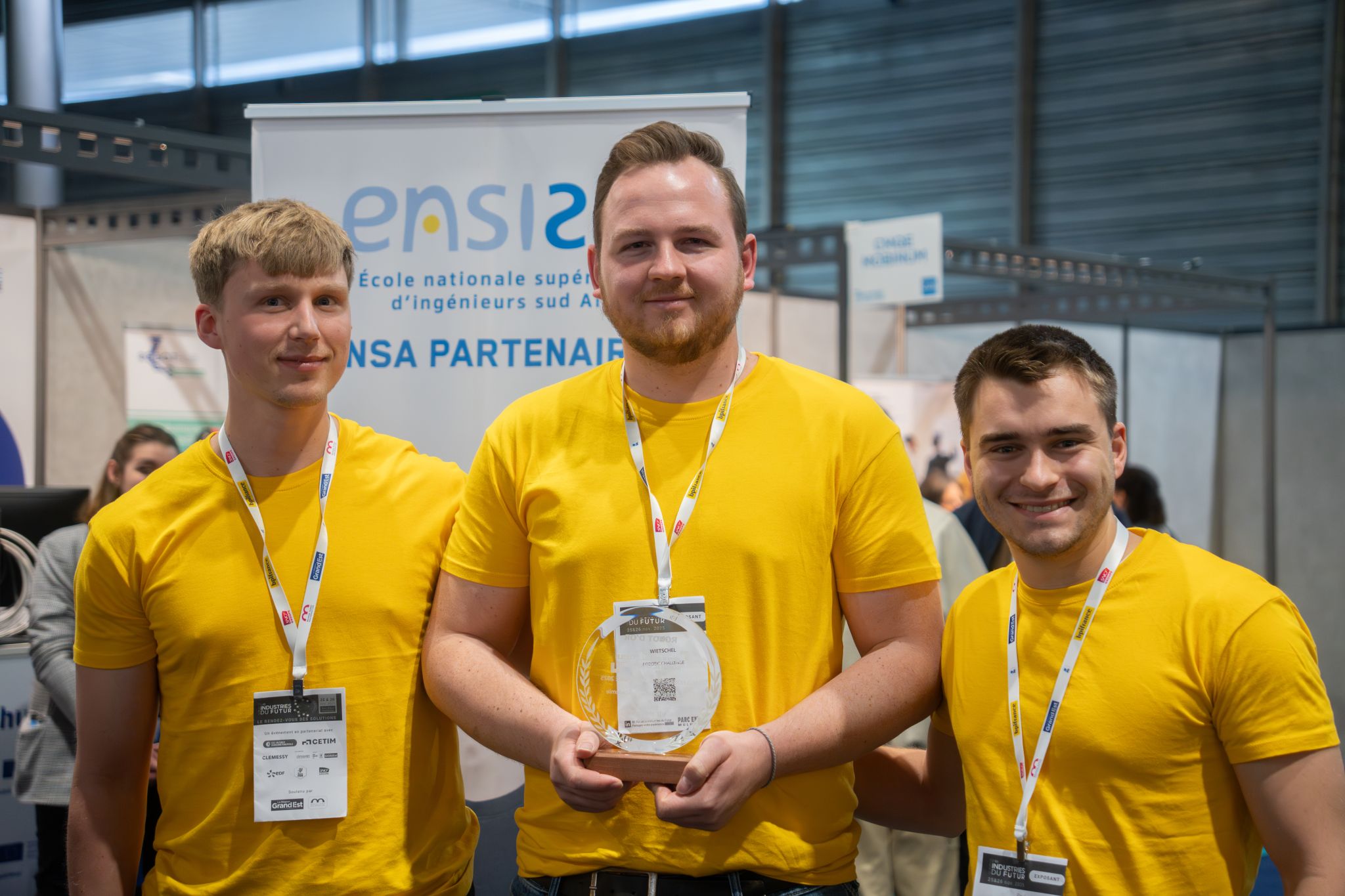
HKA student team wins the Upper Rhine Mobile Robotics Challenge 2025
At this year's Upper Rhine Mobile Robotics Challenge 2025, organized as part of BE5.0 - Industries du Futur in Mulhouse, the student team from Karlsruhe University of Applied Sciences once again prevailed against international competition. Eight teams competed against each other and put their skills in the field of mobile robotics to the test. The challenge is part of the tri-national university network TriRhenaTech and challenges the students in realistic scenarios - from autonomous navigation to visual perception and object recognition.
Complex tasks, high demands
The focus was once again on the TurtleBot, which had to complete various tasks autonomously:
- Line tracking under changing light conditions,
- navigation in unknown areas,
- signage and object recognition using the latest AI methods.
The trade fair environment in particular presented the team with special challenges: reflective floors made yellow lines appear almost white on the camera images, which required robust image processing. The team trained its own YOLO model for the recognition of signs, which ultimately performed with high reliability despite the high effort involved in labeling.
The team also benefited technically from the work of IRAS in research and teaching: experience from the DuckieTown project of Prof. Dr. Christian Wurll formed a solid basis for ROS, computer vision and line-following. At the same time, the use of ROS 2 instead of ROS 1 enabled significantly more stable and efficient navigation strategies.
Intensive preparation - strong team cohesion
The preparation time was short: around 1.5 weeks were available after the TurtleBot arrived in the laboratory. Nevertheless, the students managed to get the system ready for the challenge in intensive sessions, including several night shifts. The students particularly emphasize the team spirit, which was a decisive success factor: "We all had the same ambition. Even under stress, on site in Mulhouse, we remained calm, supported each other and found solutions together - instead of putting each other under pressure. This cooperation was one of the biggest plus points." Another team member adds: "Yes, there were a lot of ups and downs within a very short space of time, but that's exactly what brought us together as a team. Going home as winners in the end was the best confirmation of our work."
A strong result and an important success for HKA
With their victory, the team not only demonstrates technical expertise, but also how practice-oriented teaching works at IRAS: methods from research, elective subjects and student projects intertwine and enable students to successfully master demanding challenges. Karlsruhe University of Applied Sciences and IRAS would like to congratulate the team on this exceptional achievement.